Search
Get Involved
National Projects
International Projects
Children's Letters
Donors
Participation Maps
Organizations Reports
Links
Articles
How to Find A Word
Look Up A Word Here
Literacy Legacy
- Rotary Club of Tigard & Tigard Breakfast Rotary, Tualatin Rotary, OR
- Verizon TelecomPioneers / Verizon West, TX
- South Carolina Dictionary Project & Grapevine Police Dept., SC
- South Carolina Dictionary Project, SC
- South Carolina Dictionary Project & Verizon TelecomPioneers, SC
- South Carolina Dictionary Project, SC
- South Carolina Dictionary Project & Verizon TelecomPioneers, SC
- South Carolina Dictionary Project, SC
- South Carolina Dictionary Project & Verizon TelecomPioneers, SC
- Lexington Elks Lodge # 2204, MA
- South Carolina Dictionary Project, SC
- Rotary Club of Asheville, NC
- Mesquite Republican Women, TX
- Rotary Club of Bagley, MN
- Independent # 813 School District & Lake City Kiwanis Club, MN
- Rotary Club of Corinth, MS
- Sunland Tujunga Elks Lodge # 2098, CA
- Rotary Club of Newark, NJ


Mary French, Director
wordpower@
dictionaryproject.org
 

Mary French is a member 
of The Dictionary Society
of North America


March 20th 2009 declared a Dictionary Day in Minneapolis, MN


Kiwanis Tablet of Honor
(click to read)


National Community Service Award


National Association Insurance Women

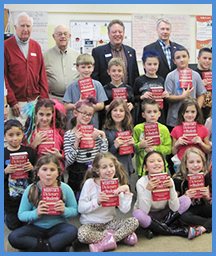
Over 11,933,557 children have received a dictionary thanks to the generosity of sponsors who have participated in the Dictionary Project. Sponsors provide a dictionary for the children in their community each year, so they can enjoy the benefits of a large vocabulary.

2,417,994 dictionaries were given to students in 2008 as a gift from people who live in their town.

The Dictionary Project is a 501(c) (3) nonprofit organization. The goal of this program is to assist all students in completing the school year as good writers, active readers and creative thinkers by providing students with their own personal dictionary. The dictionaries are a gift to each student to use at school and at home for years to come. The Dictionary Project gives 95 cents of every dollar donated toward the purchase of dictionaries.

Reading is the most important skill of all. It is the starting point for all the economic and social opportunities this world has to offer. Educators see third grade as the dividing line between learning to read and reading to learn. Every year we watch The Dictionary Project grow by expanding our pool of sponsors, so more children can enjoy the benefits of owning their own personal dictionary.

Our sponsors have made tireless efforts to improve literacy and the quality of life in their communities. These volunteers are the breath of life of The Dictionary Project. Through The Dictionary Project, people feel empowered to effect change and improve education so that the children will grow up better prepared to compete in the global economy.


A letter from June Kronholz - the writer of the Wall Street Journal story that helped expand the Dictionary Project

My friend, Beth Strelneck, called the other day to say she had delivered our dictionaries to Alpine County, Calif., which is good news. Alpine County straddles the Sierra Nevada range, and Beth got there before snow closed Carson Pass, which connects the eastern side of the county with the western side. There are two schools in Alpine County, and now they have their dictionaries. There are two reasons Beth and I are sponsoring the Dictionary Project in Alpine County, which sits north of Mono County, where Beth lives and where I vacation. The first is that the Elks in Inyo County, just to the south of us, had already ordered books for the six Mono County schools when I logged onto the Dictionary Project website this summer. Imagine that, I thought: We're in competition to give away dictionaries. The second reason dates to 2001, when I was the education reporter for The Wall Street Journal. Mary French called one day to ask that I write a story about a project she had begun to help children learn to read by giving them dictionaries.

Mary had been applying for grants for several years by then, buying dictionaries wherever she could and toting them to schools in her car. She hoped that year to give a dictionary to every third grader in her home state of South Carolina. Imagine that, I thought: Every third grader in the entire state. I wrote the story and have never had such a response in 30 years of reporting for the Journal. People called and emailed all that day, all the next and for weeks after, asking how to reach Mary and start a Dictionary Project in their own state. Mary had hit on a way to bring together adults who love words and children who are just learning to read them.

The dictionaries deepened a bond when the adults and children were neighbors, and created one when they were strangers. Mary has stayed in touch over the years. She called to tell me when the Dictionary Project began spreading across the country, and then to Asia and Africa, though the support of civic groups, clubs and churches. When she decided to publish her own dictionary-one she could print more economically and more to her liking than the big publishers could-she sent me an early version in a loose-leaf binder. She sent copies of that dictionary when it was published, and then of new versions, of an animal gazetteer and a Thesaurus. She called me about the website and its interactive map, where visitors can sign up to sponsor a school, district or county (or to find out that the Elks have gotten there first!).

A few weeks ago, Mary called to tell me that the Dictionary Project was coming close to its goal of giving a dictionary to every third grader in the country. All 4.2 million children. In all 17,000 school districts. In the entire United States. Imagine that, I thought!

-v- June Kronholz


4,170,598

This is an estimate of how many third graders there are in the United States this school year. It is an almost mind-boggling number, so it is important to bear in mind each of the individual students it represents.

They are mostly 8 or 9 years old, fairly new to the world of writing and books, and still excited about all there is to learn about the world. Remember what you learned about when you were in the third grade? The solar system? The human body? The life cycle of a plant? All of these subjects introduce new ideas to young learners, and with the new ideas comes new vocabulary.

As adults we know how important it is to be able to read and write well in order to share knowledge. We want to help young people succeed in school and in life, and we know that third grade is a crucial time for students to learn to read effectively. Dictionary Project sponsors believe that giving children dictionaries is like giving them sets of keys—tools that will unlock all the information there is to be gained from reading and will also help them write about what they learn so that they can share information with others.

We would like to put one of these valuable sets of keys in the hands of each third grader so that they will all feel empowered to open the world of ideas, get in there, and explore.


The Dictionary Project and Participation Maps

The Dictionary Project is working toward the goal of sending dictionaries to every elementary school in the United States. By doing this we hope to have a positive impact on education in this country and empower children to become skillful communicators and resourceful learners. Our country and our world face many challenges, and we need to prepare our young people to be strong, productive citizens who can succeed and grow and solve problems in a rapidly changing world. A pocket dictionary may be a small thing, but it is a powerful tool to help with learning, and when it is a gift from a child’s community, the child learns from it not just the value of school work, but also the example of community service.

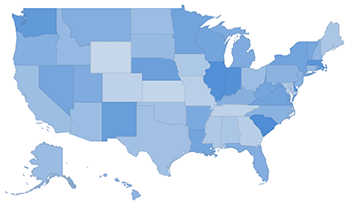
In order to help our generous sponsors spread the benefits of The Dictionary Project throughout their communities and eventually cover the whole nation, we have made some improvements to our website. The Participation Maps pages now list not just the schools our sponsors have covered, but all of the public schools in each state. The list is colorcoded to show which schools have a current sponsor, a past sponsor but not yet current one, or no sponsor at all. Donors who are able to expand their projects or new prospective donors can reference these lists to see where their help may be needed. The schools are organized by school district, so sponsors would simply need to find out which school districts are in their area and then start searching the list. It is our hope that this feature will be useful and will inspire people to help us ‘fill in the gaps’!

If you would like to start a Dictionary Project Click Here

To find a list of Dictionary Projects in your state, choose from the list below:


ABC News
Wall Street Journal
American Profile
KOTV News
The State, SC Article

Past Newsletters (2008) - (2007) - (2006)


*NEW* Dictionary Project T-Shirts


Dictionary Project wins
Angel Award


Dictionary Project wins Community Quarterback Award
Learn more here....

The Dictionary Project received the Community Quarterback Award from the Carolina Panthers and a $2,000 donation from the Carolina Panthers to the Dictionary Project.  We want to thank Chris Hope of the Kansas City Dictionary Project and Jack Vealey who helped to organize the Dictionary Project throughout Rotary District 6960 for nominating us for the award.  We are truly grateful for the participation of so many people who constantly think of new ways to do more to improve literacy where they live.


International Book Bank
has helped us with recent international projects. Check their website for more information on the organization.

Home | Get Involved | Donors | Top